As digital transformation accelerates across industries, the expectations placed on Mechatronics and Automation professionals extend far beyond theoretical knowledge. Modern enterprises require engineers and technicians who can quickly adapt to advanced manufacturing environments, understand production workflows, and master smart factory technologies.

This raises an important question for educational institutions:
Are students being exposed to learning environments that truly reflect real industrial workplaces?
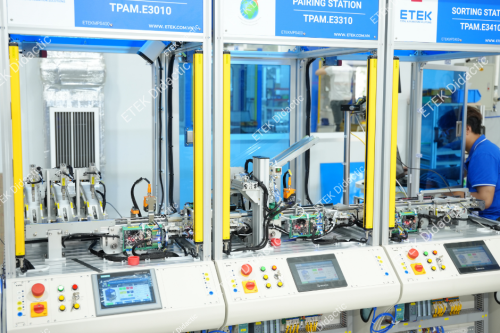
This challenge has driven ETEK to further enhance its Factory Automation Training Solutions (FATS), transforming the original 7-station training model into FATS 2026—a mini smart factory consisting of 14 integrated functional stations, delivering a training experience that is closer than ever to real-world manufacturing operations.
The previous generation of FATS was designed to help learners understand the fundamental principles of automated manufacturing systems.
Using scaled-down training components for simulation purposes, the system enabled students to:
This served as a critical first step in developing technical thinking before learners progressed to more advanced industrial systems.

With its latest generation, FATS has evolved beyond a conventional simulation platform. It is now designed to align more closely with the practical needs of modern industry.
Unlike previous training systems that primarily focused on basic educational purposes, FATS 2026 incorporates PACs and real industrial hardware, enabling students to gain hands-on experience with technologies commonly used in advanced manufacturing environments.
FATS 2026 incorporates key technologies currently deployed in modern smart factories, including:
This comprehensive integration provides learners with a holistic understanding of the smart manufacturing ecosystem.

FATS 2026 features 14 interconnected stations that form a fully integrated production line:
Through this setup, learners can observe and practice the entire manufacturing process—from material feeding and assembly to quality inspection and finished-product storage.

With its flexible architecture, FATS 2026 can replicate various manufacturing environments, including:
This enables students to engage with production scenarios that closely resemble real industrial operations.
FATS 2026 is designed not only to teach machine operation but also to develop the competencies required of modern manufacturing engineers.
Students can gain practical experience in:
These competencies help graduates become workforce-ready and better prepared for industrial environments immediately after completing their studies.

FATS 2026 was developed to serve as a bridge between technical education and industry workforce requirements.
In addition to supporting universities, colleges, and vocational institutions, the system also serves as an effective platform for corporate training programs, helping companies enhance the capabilities of engineers and technicians throughout their digital transformation journey.
The transition from a 7-station simulation system to a 14-station mini smart factory represents more than just an expansion in scale—it reflects a fundamental shift in educational philosophy.
While students once learned primarily to understand how systems work, FATS 2026 equips them to operate, manage, and optimize smart manufacturing systems in real industrial environments.
FATS 2026 brings technical education closer to industry reality, helping cultivate the highly skilled workforce required for the Industry 4.0 era.