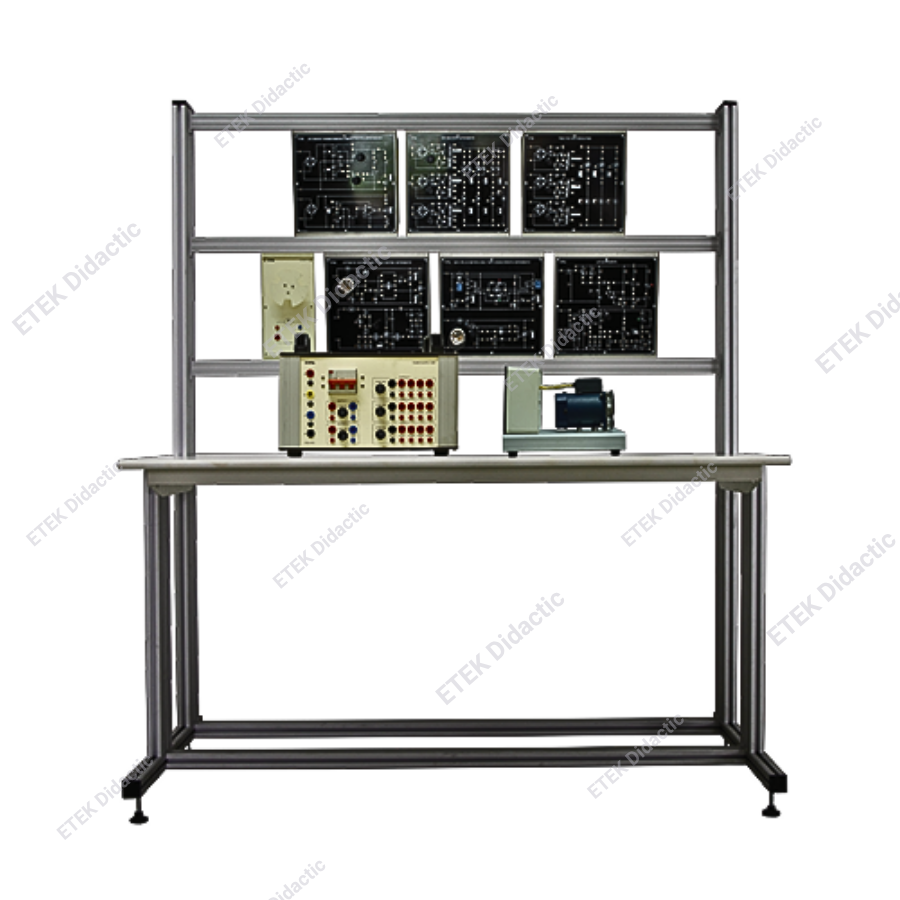
-
UJT Experiment Module – TPAP.C0100
Application
- Used for experiments on UJT power semiconductor devices, SCRs, and equivalent circuits.
Technical Specifications
- Enclosure dimensions: 300 x 272 x 130 mm (W x D x H)
- Power supply: Single-phase 12VAC/50Hz and 12VDC/1A.
- UJT: 30V/50mA.
- SCR: 800V/12A.
- Control method using photoresistor or potentiometer.
- Equipped with measurement points for current, load voltage, and control signals.
Main Components
- 01 plastic enclosure
- 01 UJT and SCR experiment circuit
-
SCR Experiment Module – TPAP.C1000
Application
- Used for DC motor control experiments using SCR and experiments on DIAC and TRIAC power semiconductor devices.
Technical Specifications
- Enclosure dimensions: 300 x 272 x 130 mm (W x D x H)
- SCR-based motor speed control section:
- Power supply: 12VDC.
- SCR: 800V/12A.
- Motor speed control using photoresistor.
- Motor reversing function included.
- Motor output: 24VDC/25W.
- DIAC and TRIAC characteristic experiment section:
- Power supply: Single-phase 36VAC/50Hz.
- DIAC: 32V/2A.
- TRIAC: 600V/4A.
- Incandescent lamp load.
- Voltage applied to DIAC and TRIAC firing angle adjustable using potentiometer.
- Equipped with measurement points for current, load voltage, and control signals.
Main Components
- 01 plastic enclosure
- 01 DC motor control, DIAC, and TRIAC experiment circuit
-
DIAC and TRIAC Experiment Module – TPAP.C2000
Application
- Used for experiments on automatic lamp control circuits and motor control circuits using TRIAC.
Technical Specifications
- Enclosure dimensions: 300 x 272 x 130 mm (W x D x H)
- Lamp brightness control circuit section:
- Power supply: Single-phase 36V/50Hz.
- DIAC: 32V/2A.
- TRIAC: 600V/4A.
- Incandescent lamp load.
- Lamp brightness adjustable using photoresistor or potentiometer.
- Motor speed control circuit section:
- Power supply: Single-phase 36V/50Hz.
- DIAC: 32V/2A.
- TRIAC: 600V/4A.
- Motor control output: 24VAC/25W.
- Motor speed control using photoresistor or potentiometer.
- Equipped with measurement points for current, load voltage, and control signals.
Main Components
- 01 plastic enclosure
- 01 lamp load and AC motor control experiment circuit
-
TRIAC AC Voltage Control Experiment Module – TPAP.G5000
Application
- Used for experiments on three-phase AC voltage control using TRIAC.
Technical Specifications
- Enclosure dimensions: 300 x 272 x 130 mm (W x D x H)
- Power supply: Three-phase 9VAC/50Hz and three-phase 24VAC/50Hz.
- SCR: 600V/12A.
- Diode: 1000V/1A.
- Lamp load: 24V.
- Firing angle controlled using potentiometer.
- Isolation between power circuit and control circuit.
Main Components
- 01 plastic enclosure
- 01 TRIAC AC control experiment circuit
-
SCR Rectifier Circuit Experiment Module – TPAP.E1100
Application
- Used for experiments on controlled and semi-controlled single-phase and three-phase rectifiers.
Technical Specifications
- Enclosure dimensions: 300 x 272 x 130 mm (W x D x H)
- Power supply: Three-phase 9V/50Hz and three-phase 12V/50Hz.
- SCR: 600V/12A.
- Diode: 1000V/1A.
- Lamp load: 24V.
- Firing angle controlled using potentiometer.
- Isolation between power circuit and control circuit.
- Can be interconnected into semi-controlled or fully controlled bridge rectifier circuits.
Main Components
- 01 plastic enclosure
- 01 SCR rectifier experiment circuit
-
JFET and MOSFET Experiment Module – TPAP.C3000
Application
- Used for experiments on JFET and MOSFET power semiconductor devices and MOSFET motor control circuits.
Technical Specifications
- Enclosure dimensions: 300 x 272 x 130 mm (W x D x H)
- JFET and MOSFET characteristic experiment section:
- Power supply: Single-phase symmetrical 12VAC/50Hz.
- N-channel JFET.
- MOSFET: 100V/33A.
- Gate drive voltage and load voltage controlled using potentiometer.
- MOSFET motor speed control section:
- Power supply: Single-phase 24VAC/50Hz.
- MOSFET: 100V/33A.
- Motor speed controlled using potentiometer.
- Motor control output: 24VDC/25W.
- Equipped with measurement points for current, load voltage, and control signals.
Main Components
- 01 plastic enclosure
- 01 JFET and MOSFET experiment circuit
-
IGBT Experiment Module – TPAP.C4000
Application
- Used for experiments on IGBT power semiconductor devices and IGBT motor control circuits.
Technical Specifications
- Enclosure dimensions: 300 x 272 x 130 mm (W x D x H)
- IGBT characteristic experiment section:
Power supply: Single-phase 12VAC/50Hz.
IGBT: 600V/40A.
Gate drive voltage and load voltage controlled using potentiometer.
- IGBT motor control section:
Power supply: Single-phase 24VAC/50Hz.
IGBT: 600V/40A.
Motor speed controlled using potentiometer.
Motor control output: 24VDC/25W.
- Equipped with measurement points for current, load voltage, and control signals.
Main Components
- 01 plastic enclosure
- 01 IGBT experiment circuit
-
Power Electronics Power Supply Module – TPAC.A7300
Technical Specifications
- Compliant with TCVN 5699-1:2010 and IEC 60335-1:2010 standards for power rating, current, leakage current, and dielectric strength.
- Input power supply: Three-phase 380VAC/50Hz.
- Output power supply:
Three-phase, each phase with voltage levels: 0 ~ 9VAC ~ 12VAC ~ 18VAC ~ 24VAC / 50Hz.
DC output: 5VDC/1A; 12VDC/1A.
- Protection functions: overload and short circuit protection.
- Integrated phase indicator lamps and cooling fan.
Main Components
- 01 set of M4 connectors
- 01 set of M2 connectors
- 01 enclosure
- 01 module panel
- 01 circuit breaker
- 03 transformers
- 03 indicator lamps
- 01 cooling fan
- 01 fuse set
-
DC Motor Training Module – TPAE.G8100
Technical Specifications
- Enclosure dimensions: 300 x 139 x 131 mm (D x W x H)
- Compliant with TCVN 5699-1:2010 and IEC 60335-1:2010 standards for power rating, current, leakage current, and dielectric strength.
- Motor type: Electromagnetic DC motor.
- Power rating: 10W.
- Rated voltage: 24VDC.
- Rated speed: 8950 rpm.
- Motor shaft equipped with rotating disc.
Main Components
- 01 phenolic panel
- 01 plastic enclosure
- 01 set of M2 connectors
- 01 set of M4 connectors
- 01 DC motor
- 01 rotating disc
-
AC Motor Training Module – TPAE.E0100
Technical Specifications
- Compliant with TCVN 5699-1:2010 and IEC 60335-1:2010 standards for power rating, current, leakage current, and dielectric strength.
- Motor type: Single-phase squirrel-cage induction motor.
- Power rating: 25W.
- Rated voltage: 24VAC.
- Rated speed: 1400 rpm.
- Frequency: 50Hz.
Main Components
- 01 plastic enclosure
- 01 phenolic panel
- 01 motor mounting base
- 01 set of M4 connectors
- 01 set of M2 connectors
- 01 single-phase squirrel-cage induction motor
- 01 rotating disc
-
Digital Waveform Measurement and Display Unit – XTDSP2102A
- Origin: China
- Bandwidth: 120 MHz
- Sampling rate: 1 GS/s
- Horizontal resolution (A/D): 12 bits
- Record length: 40M
- Refresh rate: 75,000 wfms/s
- Horizontal scale (s/div): 2 ns/div – 1000 s/div, step by 1 – 2 – 5
- Number of channels: 2 + 1 (external)
- Display: 8″ color LCD, 800 x 600 pixels, touchscreen
- Trigger modes: Edge, Video, Pulse, Slope, Runt, Windows, Timeout, Nth Edge, Logic, I2C, SPI, RS232, and CAN
- Connectivity: USB host, USB device, USB port for PictBridge, Trig Out (P/F), LAN
- Power supply: 100V – 240V AC, 50/60Hz, CAT II
- Dimensions (L x W x H): 340 x 177 x 90 mm
-
Accessory Set
Technical Specifications
- Safety connection cables, Ø4 mm
- Rated current capacity: 19A
- Sufficient number of connectors for all practical exercises
-
Technical Documentation Set
- User manuals and exercise materials, including:
- Equipment user manual
- Practical training manual
-
ETEK-Lab Digitalization, Simulation, and Practical Training Support Software
a. General Features
- Vietnamese interface, user-friendly and easy to operate.
- Web-based platform accessible through an Internet browser.
- Allows access anytime and anywhere using personal accounts.
- Supports login with individual usernames and passwords.
- Supports user role management (teachers and students).
- Supports storage and management of lecture content, learning materials, and practical training documents.
- Course content, lectures, and practical exercises can be continuously updated by users.
- Supports effective utilization of theoretical materials and practical content associated with training equipment.
- Software data deployed on the supplier’s Cloud Server.
- The software is protected by a Copyright Registration Certificate issued by the Copyright Office.
b. Lecture Development Support Functions
- Import lecture content from Word files.
- Create and edit lectures directly within the software.
- Supports insertion of visual illustrative images.
- Supports multiple types of multiple-choice questions.
- Allows creation of question banks for testing and assessment purposes.
- Lecture content management.
c. AI-Integrated Teaching Support Technology
- The software integrates Artificial Intelligence (AI) technology to support teachers in developing training content, preparing lectures, and designing tests.
- AI helps reduce lecture preparation time and supports rapid, systematic, and effective content development.
- Supports building lecture structures based on topics or course content.
- Automatically generates key lecture components including learning objectives, knowledge content, illustrative examples, and discussion questions.
- Supports summarizing lengthy documents into concise teaching content.
- Supports converting technical documents into learner-friendly lecture materials.
- Assists in editing and improving lectures and adding illustrative examples or practical scenarios.
- Generates illustrative images and visual diagrams suitable for lesson content.
- Automatically generates assessment questions from lecture content, including multiple-choice, true/false, matching, and fill-in-the-blank questions.
d. Simulation Functions
- Software for teaching and simulating fundamental principles in Power Electronics through animated and interactive simulations.
- Includes detailed theoretical content covering both basic and advanced principles.
- Theory and simulation of power electronic components and devices: insulation, semiconductors, diodes, transistors, and power electronic devices.
- Simulation of triggering and switching methods: Thyristor turn-on/turn-off methods and gate triggering methods.
- Simulation of gate drive circuits: common triggering circuits, resistor triggering circuits, half-wave and full-wave resistor triggering circuits, UJT oscillators, synchronized UJT triggering, ramp triggering circuits, and base circuits.
- Simulation of phase-controlled rectifiers.
- Simulation of voltage chopper circuits: DC-DC choppers, buck converters, boost converters, AC voltage choppers, and related applications.
- Simulation of direct frequency converters: triggering diagrams, single-phase direct inverters, and applications.
- Simulation of AC voltage controllers.