As digital transformation continues to reshape the manufacturing landscape, the expectations placed on Mechatronics and Automation professionals have evolved significantly. Today’s industries require engineers and technicians who can quickly adapt to modern production environments, understand complex manufacturing processes, and effectively utilize smart factory technologies.

This raises an important question for educational institutions: Are students truly experiencing the realities of modern industrial workplaces during their training?
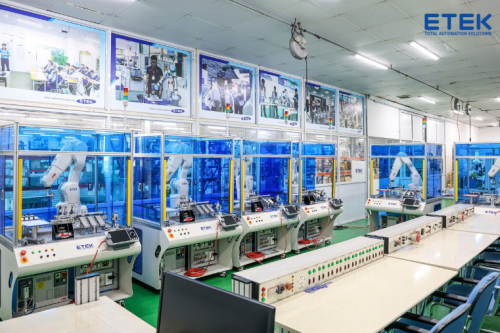
To address this challenge, ETEK has further enhanced its Factory Automation Training Solutions (FATS), transforming the original 7-station training model into FATS 2026—a comprehensive 14-station smart factory system designed to deliver a learning experience that closely mirrors real-world manufacturing operations.
The previous generation of FATS was developed to help learners understand the fundamental principles of automated manufacturing systems.
Using compact training components and simulation-based modules, the system enabled students to:
This training model served as an important first step in developing technical thinking and automation fundamentals before students progressed to more advanced industrial systems.

The next generation of FATS represents more than an upgrade in scale. It reflects a new approach to technical education—one that aligns more closely with the practical needs of modern industry.
Unlike previous training systems that primarily focused on educational simulation, FATS 2026 incorporates industrial PACs and real manufacturing equipment, allowing students to gain hands-on experience with technologies commonly found in modern factories.
FATS 2026 combines a wide range of advanced technologies currently deployed across smart manufacturing environments, including:
This integrated ecosystem enables learners to understand how various technologies interact within a smart factory environment.

FATS 2026 is designed around 14 interconnected stations that collectively simulate a complete manufacturing process:
Through this comprehensive production model, learners can observe and participate in every stage of the manufacturing process—from material feeding and assembly to quality inspection, traceability, and product storage.

The flexible architecture of FATS 2026 enables it to replicate various industrial applications, including:
This allows students to experience production scenarios that closely resemble those encountered in real industrial settings.
FATS 2026 goes beyond equipment operation training. It is designed to develop the competencies required of modern manufacturing engineers.
Students gain practical experience in:
These competencies help graduates become more adaptable and job-ready when entering today’s increasingly technology-driven manufacturing sector.

FATS 2026 was developed to serve as a bridge between technical education and workforce requirements.
In addition to supporting universities, colleges, and vocational training institutions, the platform also provides an effective solution for corporate training programs, helping businesses improve the capabilities of engineers and technicians as part of their digital transformation strategies.
The evolution from a 7-station training model to a 14-station smart factory represents more than an expansion in scale—it signifies a transformation in educational philosophy.
While previous systems focused on helping students understand automation principles, FATS 2026 empowers learners to operate, manage, and optimize smart manufacturing systems in environments that closely reflect real industrial practice.
FATS 2026 brings technical education closer to industry reality, helping develop the highly skilled workforce required for the Industry 4.0 era.