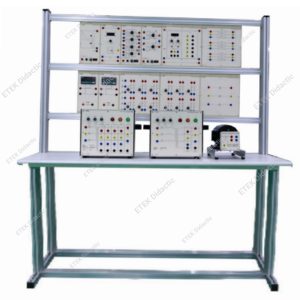
1. Three-Phase Sinusoidal PWM Inverter Module – TPAP.F2000
Technical Specifications
- Box dimensions: 300 x 272 x 131 mm (D x W x H)
- Standards:
- ISO 9001:2015 Quality Management System
- Compliant with TCVN 5699-1:2010 and IEC 60335-1:2010 standards for power/current ratings, leakage current, and dielectric strength
- Control power supply: 6VAC/3A
- Inverter power supply: 24VAC/3A
- Control method: Three-phase sinusoidal inverter
- Number of digital outputs: 6
+ 1H: High-side control signal for half-bridge 1
+ 1L: Low-side control signal for half-bridge 1
+ 2H: High-side control signal for half-bridge 2
+ 2L: Low-side control signal for half-bridge 2
+ 3H: High-side control signal for half-bridge 3
+ 3L: Low-side control signal for half-bridge 3
- Output voltage frequency displayed by 7-segment LED
- Equipped with Run and Stop push buttons
- Multi-turn potentiometer for output frequency adjustment
Main Components
- 01 Bakelite front panel
- 01 plastic enclosure
- 01 set of M4 connectors
- 01 set of M2 connectors
- 01 control circuit
- 01 display circuit
- 02 D16 push buttons
- 01 multi-turn potentiometer
2. Three-Phase Six-Step Inverter Module – TPAP.F3000
Technical Specifications
- Box dimensions: 300 x 272 x 131 mm (D x W x H)
- Standards:
- ISO 9001:2015 Quality Management System
- Compliant with TCVN 5699-1:2010 and IEC 60335-1:2010 standards for power/current ratings, leakage current, and dielectric strength
- Control power supply: 6VAC/3A
- Inverter power supply: 24VAC/3A
- Control method: Six-step inverter
- Frequency adjustment by potentiometer
- Control frequency range: 0 ~ 100Hz
- Frequency display: 7-segment LED
- Uses a three-phase MOSFET power bridge circuit
- MOSFET rating: 500V/12A
- Inverter output: Three-phase stepped AC waveform
- Phase shift angle between phases: 120°
- Rated output current: 2A
- Equipped with overcurrent protection
Main Components
- 01 Bakelite front panel
- 01 plastic enclosure
- 01 set of M4 connectors
- 01 set of M2 connectors
- 01 control circuit
- 01 display circuit
- 02 D16 push buttons
- 01 multi-turn potentiometer
3. Transformer Practice Module – TPAE.L0200
Technical Specifications
- Box dimensions: 300 x 139 x 131 mm (D x W x H)
- Standards:
- ISO 9001:2015 Quality Management System
- Compliant with TCVN 5699-1:2010 and IEC 60335-1:2010 standards for power/current ratings, leakage current, and dielectric strength
- Input power supply: 220VAC/50Hz
- Power socket integrated with fuse and switch
- Output voltages:
- Output 1: 24V/3A, M4 connectors
- Output 2: Symmetrical 6V/1A, M2 connectors
Main Components
- 01 set of M4 connectors
- 01 set of M2 connectors
- 01 plastic module enclosure
- 01 module panel
- 01 transformer
- 01 socket integrated with fuse and switch
4. AC Motor Practice Module – TPAE.F0800
Technical Specifications
- Dimensions: 219 x 180 x 160 mm (D x W x H)
- Standards:
- ISO 9001:2015 Quality Management System
- Compliant with TCVN 5699-1:2010 and IEC 60335-1:2010 standards for power/current ratings, leakage current, and dielectric strength
- Technical characteristics:
- Motor type: Three-phase squirrel-cage induction motor
- Power rating: 25W
- Rated voltage ∆/Y: 22/38VAC
- Frequency: 50Hz
Main Components
- 01 plastic enclosure
- 01 Bakelite panel
- 01 motor mounting base
- 01 set of M4 connectors
- 01 three-phase squirrel-cage induction motor
- 01 rotating disk
5. Accessories Set
- Safety connection cables, Ø4 mm
- Rated current capacity: 19A
- Sufficient quantity of connectors for all practical exercises
6. User Manuals
- Documentation includes:
- Equipment user manual
- Practical training manual
7. ETEK-Lab Digitalization, Simulation, and Practical Training Support Software
a. General Features
- Vietnamese interface, user-friendly and easy to use
- Web-based platform accessible through Internet browsers
- Allows anytime, anywhere access with personal accounts
- Supports login with individual usernames and passwords
- Supports role-based access control (teachers and students)
- Supports storage and management of lectures, learning materials, and practice documents
- Course content, lectures, and practical exercises can be continuously updated by users
- Supports effective use of theoretical and practical training materials associated with educational equipment
- Software data deployed on the supplier’s Cloud Server
- Software is certified for copyright registration by the Copyright Office
b. Lecture Development Support Functions
- Import lecture content from Word files
- Create lectures directly on the software
- Supports insertion of visual illustrations
- Supports multiple types of multiple-choice questions
- Allows creation of question banks for assessment and evaluation
- Lecture content management
c. AI-Integrated Teaching Support Technology
- The software integrates Artificial Intelligence (AI) technology to assist teachers in developing training content, preparing lectures, and designing tests
- AI helps reduce lecture preparation time and supports rapid, scientific, and effective development of training content
- Supports creating lecture structures based on topics or course content
- Automatically generates key lecture components: learning objectives, knowledge content, illustrative examples, and discussion questions
- Supports summarizing lengthy documents into key teaching points
- Supports converting technical documents into learner-friendly lecture content
- Supports editing and refining lectures, as well as adding illustrative examples and real-world scenarios
- Generates illustrations and visual diagrams suitable for lesson content
- Automatically generates assessment questions from lecture content such as multiple-choice, true/false, matching, and fill-in-the-blank questions
d. Simulation
- Software for teaching and simulating the basic principles of Power Electronics through animations and interactive simulations
- Includes detailed theoretical content covering both fundamental and advanced principles
- Theory and simulation of electronic components and power electronic devices: insulation, semiconductors, diodes, transistors, and power electronic devices
- Simulation of triggering and switching methods: Thyristor turn-on/turn-off methods and gate triggering methods
- Simulation of gate trigger circuits: common trigger circuits, resistor trigger circuits, half-wave and full-wave resistor trigger circuits, UJT oscillator, synchronized UJT triggering, ramp triggering circuits
- Simulation of phase-controlled rectifiers
- Simulation of voltage chopper circuits: DC-DC choppers, buck converters, boost converters, AC voltage choppers, and applications
- Simulation of direct inverters: triggering diagrams, single-phase direct inverters, and applications
- Simulation of AC voltage controllers